InigoInigo Logo

A Private View: a loch-side manse at one with the surrounding landscape

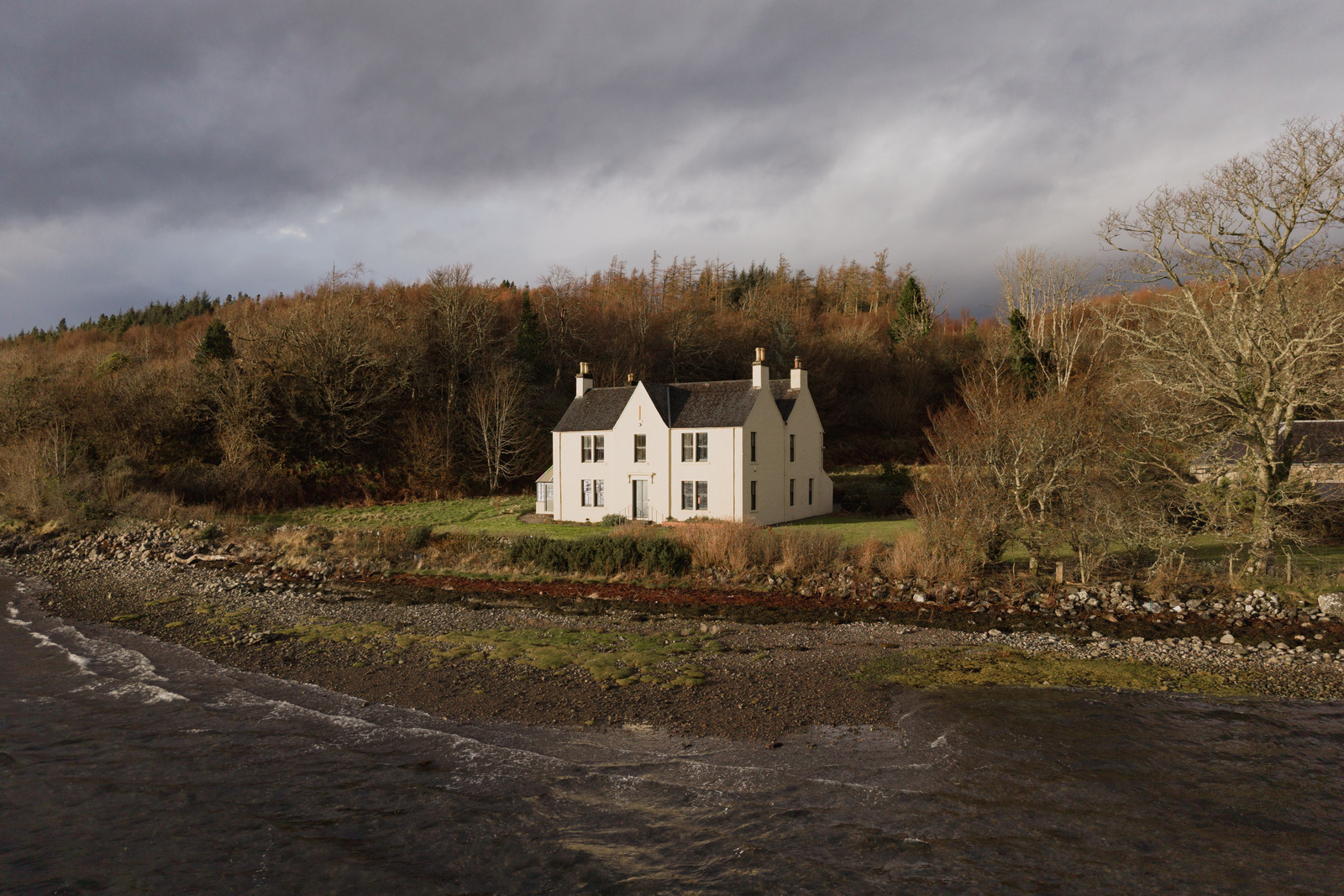
Rising amid an unaltered landscape of myth and memory, Tulach Ard sits in an otherworldly spot, embraced by woodland, water and mountains. Preserving its integrity while updating the home for contemporary living was a tall order, but something that the Stewart family – architects, designers and the founders of heritage-brand ANTA – have actualised, taking inspiration from nature’s colours and textures. Ahead of its sale, they tell Inigo of its transformation, through tartans, a sauna, and a (supposed) Thomas Telford-designed staircase…

Homes / Interiors
Words
Sophie Sims
Photography
William Pitt
A Private View: a loch-side manse at one with the surrounding landscape

Built in 1760, Tulach Ard has had plenty of time to bed into its largely unchanged loch-side terrain. It was constructed as a “very traditional West Coast manse” for the local church but has been with the Stewarts since the mid-20th century. Lachlan Stewart, co-founder of ANTA with his wife, Annie, was 10 when his parents bought the house. (An architect by training, Lachlan met Annie while the pair were at Edinburgh College of Art.) But his connection to the land stretched even further back. Their daughter Stella explains: “My grandfather’s mother was a McRae – they owned Eilean Donan, the castle down the loch. His family were always in this part of the world, so he naturally wanted to come back here when he retired.”

“Tulach Ard was derelict when my grandparents bought it in the 60s,” she continues. “They restored it and lived here full-time from the 70s. They made their life in the house – Grandpa’s brother even moved across the loch – and lived here until 2010.” It was at this point that the house, which has since been let as a holiday rental, received the trademark ANTA treatment.

Established in the 1980s, the brand is centred on traditional, timeless Scottish craftsmanship and materials (think hand-decorated homewares and accessories made from local natural materials). Tulach Ard is not a show home per se, but it does demonstrate, as Stella puts it, “what ANTA can do for interiors […] It can be used to create something really quite special”.

“I remember the whole restoration,” says Lachlan. “The process was an early introduction to architecture for me, because over the course of about five years, my parents took it all apart and put it back together again. It wasn’t a 60s style – it was totally old-fashioned. It hadn’t been touched since Edwardian times, really.”

Much like ANTA’s ethos, which is heritage-led with a contemporary sensibility, the Stewarts were conscious of the need to synthesise the history of the building with the demands of modern life. On a basic level, this included adding underfloor heating; on a visual level, the family were cautious to strike the right balance. Stella (who is the co-founder of architecture practice Ta-Ma) explains: “My grandparents kept it bright white, but we made it a slightly softer and warmer yellow. But otherwise, the outside is still as it all was. Inside, the walls are partly covered with ANTA fabric, which would have been a traditional surface in the 18th-century. But because the fabrics are contemporary designs – they’re not Victorian-style tartans – it feels modern still. Particularly in the yellow bedroom, which has linen on the walls.”

ANTA’s fabric designs were borne out of Annie’s practice as an artist. “When I trained, there was a great tradition of the Scottish Colourists. My paintings were fairly large and abstract and I started treating textile design in the same way,” she explains. ANTA’s tartans are lifted from nature and the great outdoors has informed the interior of Tulach Ard. The largest reception room, which is lined with honey-hued pine boards “feels like a cricket pavilion, or a fishing lodge,” says Annie. “It has a wonderful kind of holiday feel to it. Our son Lachlan was studying at Rhode Island School of Design at the time, and he took inspiration from the boarding on the houses there, laying the ash boards horizontally in the new long room. We used very skilled and sensitive joiners who overlapped each board and made sure the grain of the wood would carry around the room,” she says. “There was a lot of ash dieback at the time too,” adds Stella, whose practice is often centred around conservation: “It meant we weren’t chopping down new wood for the walls.”

Among Tulach Ard’s most striking original features still in situ is a sweeping staircase that coils through the core of the house. “I don’t know if it’s a myth, but it's thought to have been designed by [the Scottish civil engineer] Thomas Telford, when he designed the Caledonian Canal,” says Stella. “It’s an incredible stair: so light and fine, yet it spans three storeys. We finished it in the same yellow hue used for the woodwork throughout – which, again, was a colour popular in the 18th century.”

Outside are several traditional stone buildings, including a barn renovated by Stella and her husband, James, in 2020, which would become their home for the next five years. During this period, they also added a sauna at the water’s edge: a sublime spot to while away an afternoon – perhaps post-dip, for those brave enough. Dolphins, otters and the occasional basking shark can be spotted from here, while highland cows sometimes wade into the water on the hottest of summer days. The singularity of this spot is such that “the most boring” thing to see is “a seal eating a whole salmon for dinner,” Annie jests.

Ethereal and immutable, Tulach Ard has been allowed to gently evolve over time. “The house has so much flexibility,” says Stella. “It’s set up equally well as a business, or as somewhere to live.” At the same time, its integrity has been preserved thanks to the tenet of timeless, contextually anchored design central to the Stewarts’ outlook and, by extension, ANTA. “What we’re doing with design has been happening for several millennia,” says Annie. “And it’s not going out of fashion in a hurry.”

Tulach Ard, Loch Alsh, Scottish Highlands

view listing
A Private View: a loch-side manse at one with the surrounding landscape